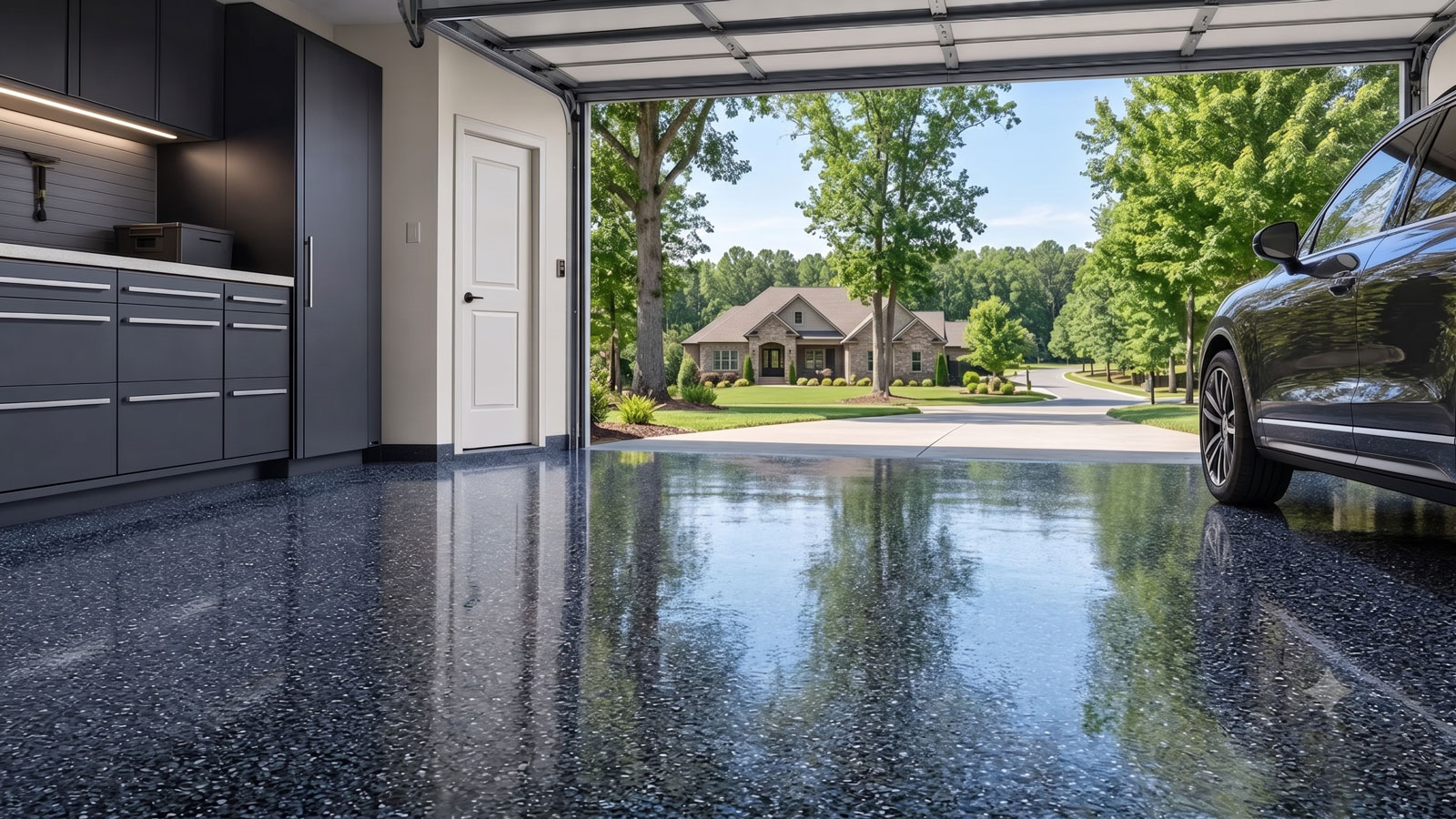
Garage Floor Coating in Rumson, NJ
Floor Coating Services in Rumson, NJ
Rumson's flood setting is unusually well documented for a small Monmouth County borough. Its official environmental inventory describes the Navesink and Shrewsbury riverbanks, identifies low-lying sections including portions of West Park and Barley Point, and counts 503 residential homes and 14 commercial buildings in the 100-year floodplain. The same report estimates about 18% of borough structures fall in that mapped area. Those are community statistics, not a ruling about a particular garage slab or address.
Rumson maintains an official flood-management plan incorporated into its Master Plan, and tidal flooding can affect some lower locations independently of an ordinary rainstorm. A garage-floor coating should not be sold as floodproofing: the correct first question is whether exterior water actually crosses the threshold, whether the driveway traps water, and whether the existing concrete has suffered past moisture-related coating failures. Floor paint, cracks, and patch materials still require separate inspection.
Winter road treatment is another distinct exposure. NJDOT documents the use of rock salt, calcium chloride, and brine; these can be carried indoors with vehicle slush and grit. After evaluating concrete soundness and any runoff, a homeowner can compare epoxy and polyaspartic systems for maintenance, UV exposure at the door, traction, and return-to-parking timing rather than assuming an affluent neighborhood needs a particular finish.
Local Market Insight
Rumson's borough environmental inventory places 503 homes and 14 commercial structures in its mapped 100-year floodplain, roughly 18% of structures. Flood risk is address-specific; a coating installer must examine the actual slab, exterior threshold and prior finishes instead of inferring conditions from river proximity.
What Affects the Cost of Garage Floor Coating in Rumson?
Rumson's tidal and riverbank setting changes how a garage owner should evaluate an entry, but the borough's floodplain statistics are not a coating specification. If water actually crosses the driveway apron, that is a separate drainage question from old floor paint, cracks, and mechanical profiling.
A quote should itemize preparation, stable-defect repairs, junctions at the garage door, storage access and the chosen finish system. Riverfront location without address-specific evidence is not a valid reason to add moisture products.
The published range is $6–$12 per sq. ft., and a typical two-car garage often falls in the $3,000–$5,500 range. Floor size, concrete condition, preparation, coating system, and finish selection determine the final quote.
- Riverbank and floodplain mapping: Rumson's inventory counts 503 homes and 14 commercial structures in the mapped 100-year floodplain. That does not describe every garage. Check address-specific maps and real threshold water instead of using the borough percentage to set coating scope.
- Navesink and Shrewsbury entry paths: Low-lying areas next to both rivers and certain tidally affected streets are documented. On-site driveway pitch and garage-door conditions, not river proximity alone, determine whether exterior runoff must be handled.
- Prior floor finishes: High-value property does not prove a sound slab. Evaluate old floor paint, sealers, oil staining, patch materials and any previous resin failure before specifying grinding.
- Cracks and movement: Document stable repairs and functional control joints separately. Bridging an active joint for appearance may create problems a resin coating cannot solve.
- Winter brine and residue: NJDOT uses salt, calcium chloride and brine on winter roads. Prep should remove contamination and a finished floor still needs seasonal grit and salt cleanup.
- System details and timing: UV stability near an open door, decorative flake density, traction, storage clearance, and return-to-vehicle time affect value independently of coating brand.
Call for a clear, project-specific estimate — or request one online.
Rumson's Tidal Flood Map and Private Garage Entry
The Borough of Rumson maintains a formal flood-management program under its Master Plan. Its environmental resource inventory documents susceptibility along both the Navesink and Shrewsbury waterfronts and identifies specific lower areas, including West Park and parts of the Barley Point vicinity, where flooding is a recognized community concern.
The inventory also provides a documentary count: 503 residential homes and 14 commercial buildings in the 100-year mapped floodplain, representing about 18% of borough structures. That statistic is unusually informative, but it is not a finding that 18% of garage floors need a moisture barrier or that any given inland address faces tidal inflow.
For a coating project, the useful inspection happens where the driveway meets the door. Observe whether water arrives repeatedly from outside, whether it pools against the concrete lip, and whether earlier coatings failed in the same location. Separate occasional wet-tire puddles from exterior flooding and slab-related dampness.
If the garage has a recurring outside water path, correct drainage or flood-exposure concerns independently. Only then should an installer plan paint removal, grinding, stable crack repair, movement-joint treatment and a finishing system suited to the actual concrete.
Rumson Winter Road Treatments and Garage Finish Expectations
NJDOT's winter operations use rock salt and salt brine or calcium-chloride blends on roads. Rumson cars can carry this residue into a garage during icy weather, especially where vehicles are frequently parked after longer regional trips. The material must be cleaned from concrete before coating and removed from the finished surface during regular maintenance.
A polished garage appearance can be a priority, but protective performance is determined by preparation and the specified layers. In any Rumson home, old floor paint, past repairs, porous areas, stains or moving joints can require distinct treatment; a high property value says little about those conditions.
An estimate should also discuss how bright sunlight reaches the front portion of the floor, what texture is appropriate for wet shoes, and whether the garage needs to function as a household entrance throughout the job. Faster curing is valuable only when the manufacturer's substrate and weather requirements have been met.
Ask to see the system specification and an itemized preparation plan. A floodplain designation, a luxury finish name, or a claim that polyaspartic always beats epoxy is not a substitute for examining the actual floor.
Frequently Asked Questions
Does Rumson's 18% floodplain figure mean my garage will flood?
No. The figure refers to structures in the mapped 100-year floodplain, based on borough inventory figures. Risk and water behavior are address-specific. A coating cannot prevent exterior floodwater from entering.
Are the Navesink and Shrewsbury rivers relevant to indoor garage coatings?
They are local exposure context, especially in low-lying mapped areas. Inspect real threshold conditions, prior delamination and the slab itself; do not infer moisture vapor from a river name.
Can a new coating withstand winter salt without cleaning?
It should not be sold as maintenance-free. NJDOT deicing products can enter with vehicles; follow the finish manufacturer's cleaning advice and remove concentrated grit and residues.
Will a high-end Rumson garage automatically need polyaspartic?
No. Compare epoxy and polyaspartic assemblies based on substrate preparation, sunlight, cure schedule, traction, desired finish and the specific product datasheets.
What must a Rumson quote specify?
Concrete profiling, prior-finish removal, crack and joint work, steps and thresholds, the named coating layers, exclusion of external flood fixes and return-to-vehicle timing.
Rumson Neighborhoods & Local Context
Typical Project Cost
$3,000–$5,500
Typical two-car range. Final pricing depends on floor size, concrete condition, preparation, coating type, and finish options.
Helpful Guides